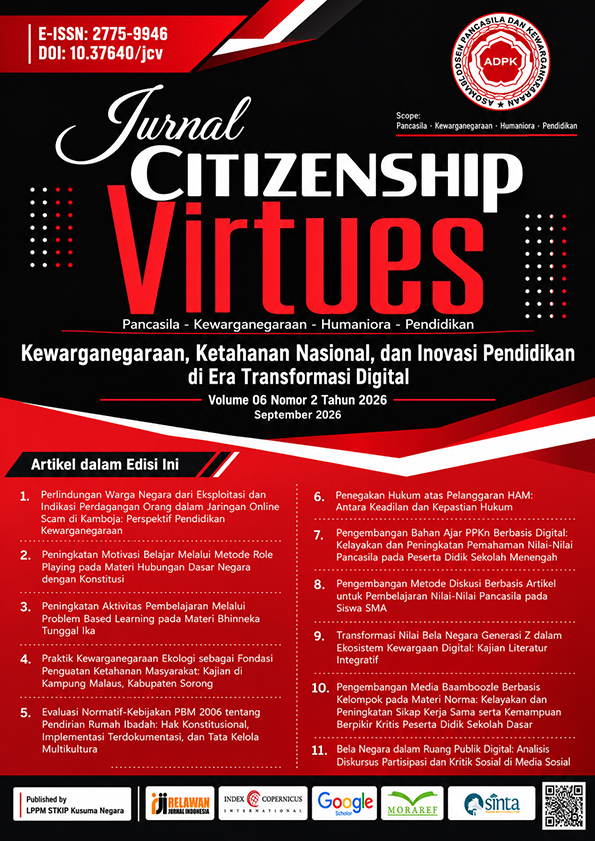
Transformasi Nilai Bela Negara Generasi Z dalam Ekosistem Kewargaan Digital: Kajian Literatur Integratif
DOI:
https://doi.org/10.37640/jcv.v6i2.2840Keywords:
Bela negara, Generasi Z, Kewargaan digital, Nasionalisme, Civic agencyAbstract
Digitalisasi telah mengubah ruang, bentuk, dan kompetensi kewargaan Generasi Z, sehingga pemaknaan bela negara tidak lagi memadai jika hanya dipahami melalui kerangka konvensional. Penelitian ini bertujuan menganalisis transformasi nilai bela negara pada Generasi Z dan membangun kerangka konseptual yang menjelaskan perubahan tersebut dalam ekosistem kewargaan digital. Penelitian menggunakan kajian literatur integratif terstruktur terhadap 25 artikel terbitan 2021–2026 yang dipilih dari 35 kandidat berdasarkan relevansi, kualitas sumber, dan kontribusinya terhadap konsep transformasi. Data dianalisis melalui sintesis tematik dan dikoding ke dalam lima dimensi. Hasil menunjukkan bahwa transformasi berlangsung melalui perubahan orientasi nilai, arena kewargaan, bentuk tindakan, karakter ancaman, dan kompetensi kewargaan. Digitalisasi memperluas ruang kewargaan menuju networked civic space, mendorong networked civic action, menghadirkan ancaman informasional, dan meningkatkan kebutuhan terhadap literasi digital kritis, etika digital, civic judgement, serta civic agency. Perubahan tersebut berkontribusi terhadap rekonstruksi patriotisme normatif menuju nasionalisme yang lebih kritis, reflektif, kontekstual, dan partisipatif. Penelitian ini mengusulkan critical digital civic agency sebagai kapasitas kunci dalam transformasi bela negara Generasi Z.
References
Akbar, R. S., Iskandar, T., Prasetyo, M. A., Damayanti, T. O., Khomaidi, M. I., Abadi, M. D., Bachtiar C. R., S., & Renhard, R. (2024). Memperkuat ketahanan nasional: Aktualisasi bela negara melalui literasi digital. Journal on Education, 6(4), 18838–18849. https://doi.org/10.31004/joe.v6i4.5867
Amalia, A. R., & Wahidin, D. (2025). Peran media sosial dalam meningkatkan kesadaran bela negara Generasi Z. Jurnal Pertahanan dan Bela Negara, 15(2), 99–120. https://doi.org/10.33172/jpbh.v15i2.19813
Dwertmann, D. J. G., & van Knippenberg, D. (2021). Capturing the state of the science to change the state of the science: A categorization approach to integrative reviews. Journal of Organizational Behavior, 42(2), 104–117. https://doi.org/10.1002/job.2474
Fahzaria, N. A., Permatasari, A. N., & Putra, R. P. (2026). Exploring meaning, motivation, and nationalism among Indonesian Gen Z in the #KaburAjaDulu digital campaign: A phenomenological study. CHANNEL: Jurnal Komunikasi, 14(1), 31–44. https://doi.org/10.12928/channel.v14i1.1858
Grant, M. J., & Booth, A. (2009). A typology of reviews: An analysis of 14 review types and associated methodologies. Health Information & Libraries Journal, 26(2), 91–108. https://doi.org/10.1111/j.1471-1842.2009.00848.x
Hariyanti, H., Darmawan, C., Rahmat, R., Anggraeni, L., Rafni, A., Radini, R., & Hasibuan, H. A. (2026). Social media: A means of developing Generation Z’s political participation in the digital era. Jurnal Civics: Media Kajian Kewarganegaraan, 23(1), 80–95. https://doi.org/10.21831/jc.v23i1.90231
Lubbe, W., ten Ham-Baloyi, W., & Smit, K. (2020). The integrative literature review as a research method: A demonstration review of research on neurodevelopmental supportive care in preterm infants. Journal of Neonatal Nursing, 26(6), 308–315. https://doi.org/10.1016/j.jnn.2020.04.006
Lu, C., & Gu, M. M. (2025). A systematic review and meta-analysis of factors and outcomes of digital citizenship among adolescents. Asia Pacific Journal of Education, 45(4), 1130–1145. https://doi.org/10.1080/02188791.2023.2296352
Martian, F., Cempaka Harum, A., Aldama, A., Febriana, M., & Pratama, S. B. (2024). Konstruksi nasionalisme Generasi Z di era media digital dalam membangun ketahanan informasional. Jurnal Riset Manajemen Komunikasi, 4(2), 133–140. https://doi.org/10.29313/jrmk.v4i2.4399
McDaniel, D. S. (2024). “Bold of them to assume I want to wait until I’m older to do what I love:” One teens’ activism and civic engagement online. Journal of Adolescent & Adult Literacy, 67(6), 363–375. https://doi.org/10.1002/jaal.1343
Mulyono, B., Affandi, I., Suryadi, K., & Darmawan, C. (2022). Online civic engagement: Fostering citizen engagement through social media. Jurnal Civics: Media Kajian Kewarganegaraan, 19(1), 75–85. https://doi.org/10.21831/jc.v19i1.49723
Oden, A., & Porter, L. (2023). The kids are online: Teen social media use, civic engagement, and affective polarization. Social Media + Society, 9(3). https://doi.org/10.1177/20563051231186364
Opoku, E., Quayson, E., Arthur, F., Salifu, I., Asare-Bediako, S., Attom, E. R., Boateng, E., & Nortey, S. A. (2025). Digital citizenship among economics students: The synergy of internet political activism, technical skills, critical perspective and networking agency. Discover Education, 4, Article 344. https://doi.org/10.1007/s44217-025-00620-5
Pangrazio, L., & Sefton-Green, J. (2021). Digital rights, digital citizenship and digital literacy: What’s the difference? Journal of New Approaches in Educational Research, 10(1), 15–27. https://doi.org/10.7821/naer.2021.1.616
Prasetya, H. (2021). Upaya bela negara Generasi Z berbasis pengembangan media sosial. Jurnal Kebangsaan, 1(2), 53–61. https://doi.org/10.51170/jk.v1i2.222
Prasetyo, D., Muharam, R. S., Subagio, H., Yulianto, W. W. E., & Sudaryatie, S. (2024). Implementasi pendidikan kewarganegaraan dalam menguatkan identitas matakuliah bela negara di era digital. Academy of Education Journal, 15(2), 1329–1336. https://doi.org/10.47200/aoej.v15i2.2353
Republik Indonesia. (1945). Undang-Undang Dasar Negara Republik Indonesia Tahun 1945.
Richardson, J. W., Martin, F., & Sauers, N. (2021). Systematic review of 15 years of research on digital citizenship: 2004–2019. Learning, Media and Technology, 46(4), 498–514. https://doi.org/10.1080/17439884.2021.1941098
Sari, Y., Suyato, S., Mulyono, B., & Murdiono, M. (2025). Generation Z Instagram activism: Between slacktivism and online civic engagement in Indonesia’s democracy. Journal of Governance and Local Politics, 7(2), 275–286. https://doi.org/10.47650/jglp.v7i2.2307
Saud, M., & Margono, H. (2021). Indonesia’s rise in digital democracy and youth’s political participation. Journal of Information Technology & Politics, 18(4), 443–454. https://doi.org/10.1080/19331681.2021.1900019
Schmitt, J. B., Baake, J., & Kero, S. (2024). What means civic education in a digitalized world? Frontiers in Psychology, 15, 1257247. https://doi.org/10.3389/fpsyg.2024.1257247
Snyder, H. (2019). Literature review as a research methodology: An overview and guidelines. Journal of Business Research, 104, 333–339. https://doi.org/10.1016/j.jbusres.2019.07.039
Sobari, W. (2026). Reimagining citizenship in electoral times: Lessons from Gen Z’s digital civics prototypes for Indonesia’s 2024 election. Jurnal Civics: Media Kajian Kewarganegaraan, 23(1), 1–17. https://doi.org/10.21831/jc.v23i1.90563
Subagio, H., Yulianto, W. W. E., Prasetyo, D., & Muharam, R. S. (2022). Penguatan karakter bela negara di era revolusi digital melalui pendidikan kewarganegaraan. Jurnal Moral Kemasyarakatan, 7(1), 79–93. https://doi.org/10.21067/jmk.v7i1.6886
Tadlaoui-Brahmi, A., Çuko, K., & Alvarez, L. (2022). Digital citizenship in primary education: A systematic literature review describing how it is implemented. Social Sciences & Humanities Open, 6(1), 100348. https://doi.org/10.1016/j.ssaho.2022.100348
Tarsidi, D. Z., Suryadi, K., Budimansyah, D., & Rahmat, R. (2023). Social media usage and civic engagement among Indonesian digital natives: An analysis. Jurnal Civics: Media Kajian Kewarganegaraan, 20(2), 257–269. https://doi.org/10.21831/jc.v20i2.60812
Thomas, J., & Harden, A. (2008). Methods for the thematic synthesis of qualitative research in systematic reviews. BMC Medical Research Methodology, 8, Article 45. https://doi.org/10.1186/1471-2288-8-45
Torraco, R. J. (2016). Writing integrative literature reviews: Using the past and present to explore the future. Human Resource Development Review, 15(4), 404–428. https://doi.org/10.1177/1534484316671606
Vissenberg, J., De Coninck, D., Mascheroni, G., Joris, W., & d’Haenens, L. (2023). Digital skills and digital knowledge as buffers against online mis/disinformation? Findings from a survey study among young people in Europe. Social Media + Society, 9(4). https://doi.org/10.1177/20563051231207859
Whittemore, R., & Knafl, K. (2005). The integrative review: Updated methodology. Journal of Advanced Nursing, 52(5), 546–553. https://doi.org/10.1111/j.1365-2648.2005.03621.x
Wilf, S., Maker Castro, E., Garzón Gupta, K., & Wray-Lake, L. (2023). Shifting culture and minds: Immigrant-origin youth building critical consciousness on social media. Youth & Society, 55(8), 1589–1614. https://doi.org/10.1177/0044118X221103890
Yulnelly, Y., & Setiyawati, M. E. (2022). Pemahaman nilai-nilai bela negara generasi muda dalam menghadapi informasi di era digital. IKRA-ITH HUMANIORA: Jurnal Sosial dan Humaniora, 7(2), 122–132. https://doi.org/10.37817/ikraith-humaniora.v7i2.2298
Zhang, W., Chen, Z., Chia, Y.-T., & Neoh, J. Y. (2022). Rethinking civic education in the digital era: How media, school, and youth negotiate the meaning of citizenship. International Communication Gazette, 84(4), 287–305. https://doi.org/10.1177/17480485221094101.
Downloads
Published
Issue
Section
License
Copyright (c) 2026 Jurnal Citizenship Virtues

This work is licensed under a Creative Commons Attribution-ShareAlike 4.0 International License.
Author(s) agree that this article remains permanently open access under the terms of the Creative Commons Attribution-ShareAlike 4.0 International License